In this article we explore how to implement asynchronous processing in a Django project (including Django REST Framework) using Celery and Amazon SQS. We explain the basics and the practical configuration for both local and production environments, including using Docker and LocalStack to simulate SQS. The goal is for even beginners to understand and run asynchronous tasks in a scalable and reliable way.



Asynchronous processing is a key technique to improve performance and scalability in modern web applications. In frameworks like Django, it reduces response times by delegating heavy or long-running tasks to background processes. In this article you'll learn how to integrate Celery with Amazon SQS to build a robust asynchronous processing architecture. We'll also cover how to set up a local development environment using Docker and LocalStack so you can develop without depending directly on AWS.
Asynchronous processing works through a queue system composed of these elements:
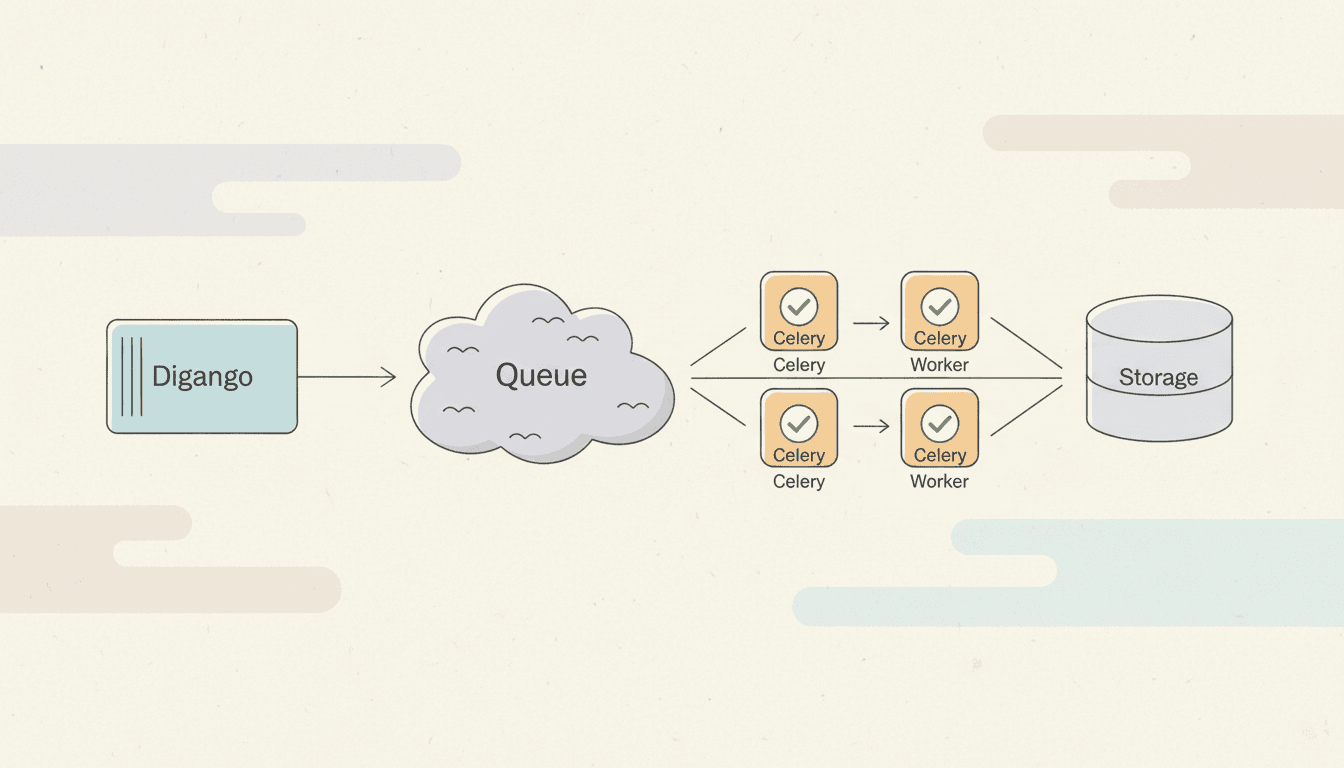
It’s important to understand that receiving a message does not automatically remove it. Processing must be explicitly acknowledged to avoid duplications.
In this setup we use:
To run the system correctly:

With Docker Compose you can:
This separation allows responsibilities to be isolated and lets you scale workers independently.

Asynchronous processing: Technique that runs tasks in the background without blocking the system’s main response. Broker: Intermediary system that manages message queues between producers and consumers. Worker: Process that consumes messages from a queue and executes associated tasks. FIFO queue: Queue type where messages are processed in the same order they were sent. Visibility Timeout: Time during which a received message remains hidden before it can be processed again.